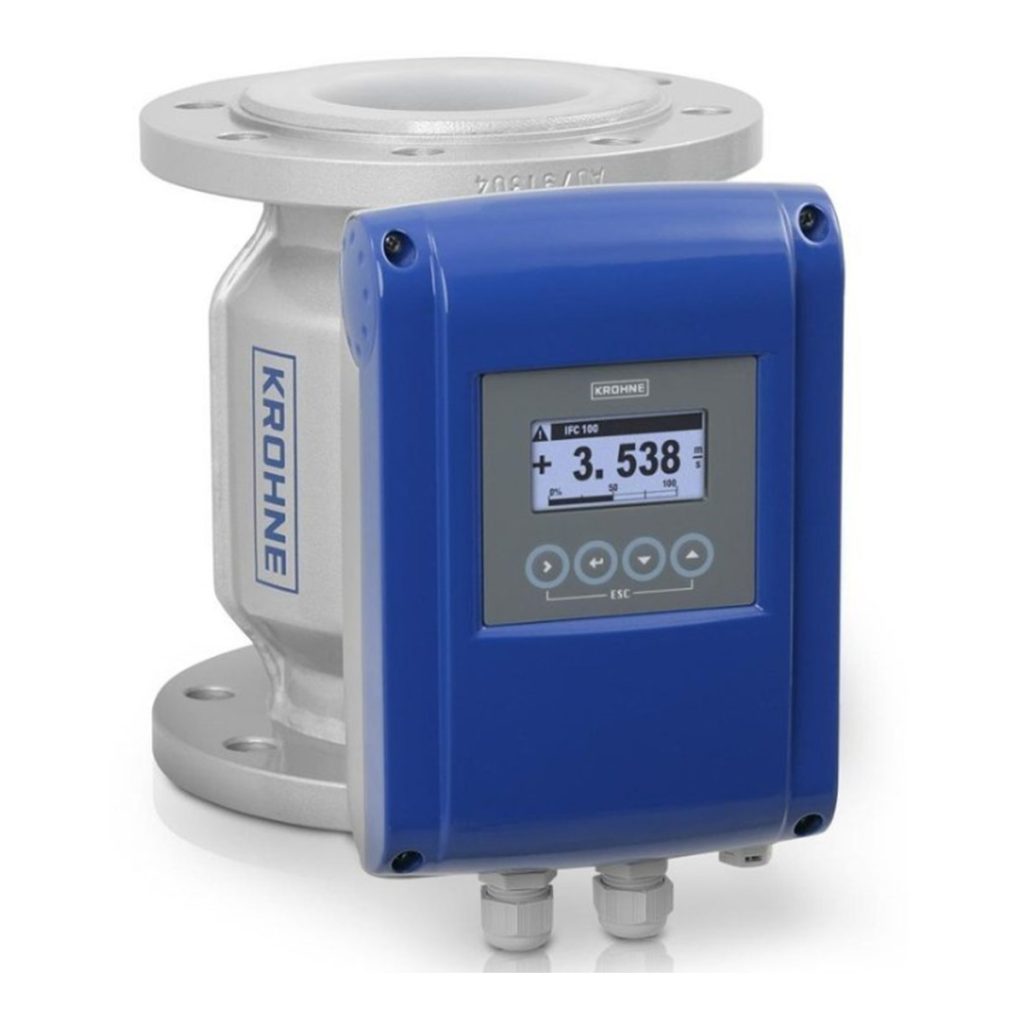
KROHNE OPTIFLUX 2100 C Electromagnetic Flowmeter
KROHNE OPTIFLUX 2100 C is a compact electromagnetic flowmeter for standard water and wastewater applications and other compatible conductive liquids. It combines an OPTIFLUX 2000 flow sensor with an IFC 100 signal converter.
Available configurations cover DN25–DN1200 with configuration-dependent lining, pressure class, power supply and output options.
For replacement or new-project selection, send the complete model code, nameplate photo or operating conditions. AERX can review the configuration before quotation.
Technical Attributes
- Measuring principle
- Electromagnetic / Faraday's law
- Primary application
- Standard water and wastewater applications
- Medium
- Electrically conductive liquids
- Flow sensor
- OPTIFLUX 2000
- Signal converter
- IFC 100
- Version
- Compact (C)
- Nominal size family
- DN25–DN1200 / 1–48 in
- Process connection
- Flange
- Pressure class family
- Up to PN40 / ASME Class 300, configuration dependent
- Standard accuracy
- ±0.3% of measured value; exact conditions/configuration apply
- Conductivity
- ≥5 μS/cm; water ≥20 μS/cm
- Outputs
- 4–20 mA, pulse, frequency, status, HART®
- Flow direction
- Bidirectional measurement supported
- Measuring tube
- Full bore
- Moving measuring parts
- None
- Liner family
- PP or hard rubber; exact liner depends on configuration
- Calibration
- Standard wet calibration
Applications and Description
Need the exact OPTIFLUX 2100 C configuration?
Send your model code, nameplate photo or application conditions. AERX can review the configuration before quotation.
Email: sales@aerxcontrols.com
WhatsApp: +86 177 6226 1830
Product Overview
The OPTIFLUX 2100 C is designed for reliable flow measurement of conductive liquids in standard water and wastewater applications.
The compact measuring system combines the OPTIFLUX 2000 electromagnetic flow sensor with the IFC 100 signal converter. Depending on the selected configuration, the instrument can provide current, pulse, frequency, status and HART communication outputs.
The full-bore sensor contains no moving measuring parts in the flow path. This makes the product suitable for many general water and wastewater duties where a robust electromagnetic measuring principle is preferred.
Because liner, electrode, pressure, electrical and approval options can vary by order code, replacement instruments should be confirmed using the complete model code or existing nameplate rather than appearance alone.
Typical Applications
- Water treatment
- Water distribution
- Wastewater collection
- Wastewater treatment
- Industrial process water
- Utility water systems
- Compatible conductive process liquids
Selection note: Media conductivity and material compatibility must be confirmed before final selection.
How Electromagnetic Measurement Works
Electromagnetic flow measurement uses Faraday’s law of electromagnetic induction. When a conductive liquid moves through the magnetic field generated by the sensor, an induced voltage is detected by the electrodes and used to determine flow velocity and volumetric flow.
Because the measuring principle depends on electrical conductivity, electromagnetic flowmeters are intended for conductive liquids rather than gases or non-conductive fluids.
Configuration & Selection Points
Before quotation or model confirmation, check the following information:
- Pipe size / DN
- Measured medium
- Electrical conductivity, if known
- Minimum, normal and maximum flow
- Process pressure
- Process temperature
- Flange / process connection standard
- Liner requirement
- Electrode material requirement
- Output / communication requirement
- Power supply
- Installation environment
- Quantity
For replacement projects, send the complete existing nameplate whenever possible.
Installation Considerations
The measuring tube should remain completely filled during normal operation. Avoid installation conditions that can create persistent empty-pipe or excessive entrained-air conditions.
Confirm pipe and flange compatibility, grounding, installation orientation and available straight-run space before installation.
Exact installation requirements should be checked against the applicable KROHNE documentation for the selected configuration. Do not apply one universal straight-pipe rule to every installation.
Replacing an existing OPTIFLUX flowmeter?
Send AERX:
- complete model / order code;
- nameplate photo;
- sensor and converter photos if available;
- pipe size;
- process medium;
- flow range;
- pressure;
- temperature;
- flange / connection standard;
- required output or communication;
- quantity.
AERX can review the identification and requested configuration before quotation.
Product-Specific FAQ
Can I replace my existing OPTIFLUX meter with an OPTIFLUX 2100 C?
Possibly, but the model family alone is not enough to confirm interchangeability. Send the complete model code or a clear nameplate photo together with pipe size, flange standard and output requirements. AERX can compare the requested configuration before quotation.
What information should I send if I do not know the full model code?
A clear nameplate photo is the best starting point. Photos of the converter, sensor and process connection can also help. For a new application, provide the medium, pipe size, flow range, pressure, temperature and required output.
How do I choose the correct liner for my application?
Liner selection depends on the liquid, process temperature and chemical compatibility. The final liner should be confirmed from the actual operating conditions rather than selected only by price or appearance.
Can the OPTIFLUX 2100 C measure low-conductivity liquids?
Only when the liquid conductivity meets the electromagnetic measurement requirements of the selected configuration. If conductivity is unknown, provide the medium name or conductivity value before selection.
Should I choose the compact version or a remote version?
A compact version is suitable when the converter can be mounted directly on the sensor under acceptable site conditions. A remote arrangement may be preferable where accessibility, flooding, temperature, vibration or other installation constraints require the converter to be installed away from the measuring point.
Can my existing PLC or DCS receive the signal from this flowmeter?
It depends on the configured output and the control-system input. Confirm whether the project requires 4–20 mA, pulse, frequency, status output or HART communication before ordering.
What should I check before installation?
Confirm pipe size and flange compatibility, installation orientation, full-pipe conditions, grounding, available straight-run space and the applicable installation instructions for the exact configuration.