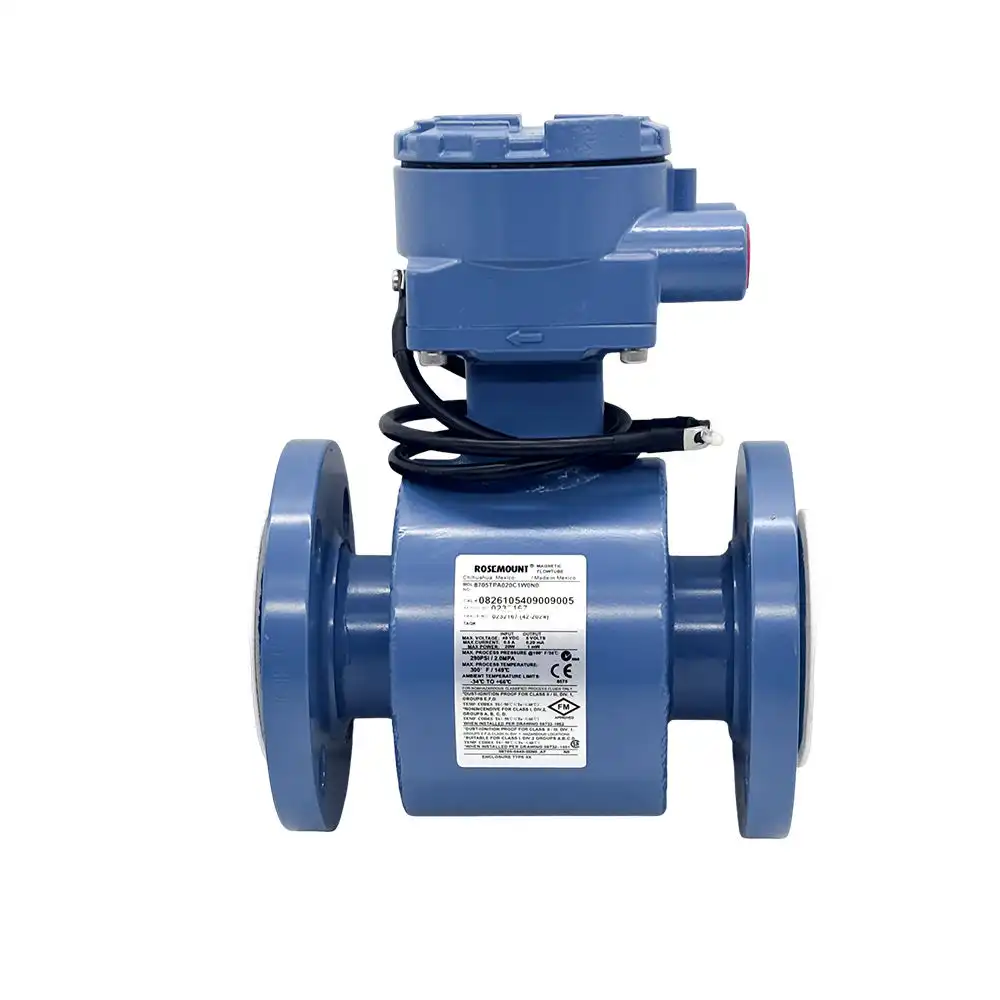
Rosemount 8705 Flanged Magnetic Flow Meter Sensor
Rosemount 8705 is a flanged electromagnetic flow meter sensor for conductive liquids and slurries. Its all-welded, hermetically sealed sensor housing is designed to protect internal components and wiring from moisture and process-environment contamination.
The obstructionless measuring tube contains no moving parts, while the removable terminal block supports field service without replacing the complete sensor.
For a complete magnetic flow measurement system, the 8705 sensor must be paired with a compatible Rosemount transmitter. For replacement projects, send the complete sensor model string, nameplate and existing transmitter information so the configuration can be checked before quotation.
Technical Attributes
- Measuring principle
- Electromagnetic / magnetic flow measurement
- Product type
- Flanged magnetic flow meter sensor
- Typical media
- Electrically conductive liquids and slurries
- Line-size family
- 1/2–36 in. (15–900 mm)
- Maximum flow velocity
- Up to 39.37 ft/s (12 m/s)
- Minimum liquid conductivity
- 5 μS/cm
- Sensor construction
- All-welded, hermetically sealed housing
- Flow path
- Obstructionless; no moving measuring parts
- Terminal block
- Removable and replaceable
- System accuracy
- Depends on transmitter and ordered configuration; Rosemount documentation lists 0.25% standard and a 0.15% high-accuracy option for the 8705 family
- Liner options
- Available liner materials vary by order code and application
- Electrode material
- Selected according to process medium and order code
- Process connection
- Flanged; exact flange standard/rating varies by order code
- Process temperature
- Depends on liner and ordered configuration
- Compatible transmitter
- Confirm by system configuration; current Rosemount magnetic flow systems commonly use 8732EM or 8712EM transmitters
- Submergence / environmental protection
- Available protection depends on ordered configuration and correct conduit/cable sealing
- Calibration / sensor data
- Confirm from the sensor nameplate and calibration information
Applications and Description
Need to confirm a Rosemount 8705 replacement?
Send the complete sensor model string, nameplate photo and existing transmitter information. For a new application, include the process medium, line size, flow range, pressure, temperature, flange requirement and installation environment.
Email: sales@aerxcontrols.com
WhatsApp: +86 177 6226 1830
Product Overview
The Rosemount 8705 is a flanged electromagnetic flow sensor designed for conductive process liquids and slurries. The sensor uses the electromagnetic measuring principle and provides an open, obstructionless flow path without moving measuring components.
Its all-welded sensor body provides a hermetic seal around the internal components and wiring. This construction is intended to improve long-term reliability in demanding process environments where moisture and contamination can be a concern.
A removable and replaceable terminal block supports field maintenance. Depending on the ordered configuration, the 8705 can be supplied with different lining, electrode, flange, pressure and environmental-protection options.
The sensor is one part of the magnetic flow measurement system. The exact transmitter pairing, electrical interface and final system performance must be checked against the complete sensor and transmitter configuration.
Typical Applications
- Water and wastewater systems
- Industrial process water
- Chemical process liquids compatible with the selected liner and electrode materials
- Pulp and paper process streams
- Mining and slurry applications where the selected materials are suitable
- Other electrically conductive liquids within the sensor configuration limits
Selection note: Fluid conductivity, chemical compatibility, abrasion, process temperature and pressure must be considered before the liner and electrode materials are finalized.
How the Measurement System Works
The Rosemount 8705 sensor operates on Faraday’s law of electromagnetic induction. A magnetic field is applied across the measuring tube. When an electrically conductive liquid moves through that field, the electrodes detect a voltage related to fluid velocity.
The sensor signal is processed by a compatible magnetic flow transmitter to calculate and output flow information. Because this measuring principle depends on electrical conductivity, the application must use a conductive liquid or slurry.
Configuration & Selection Points
Before quotation or replacement confirmation, check:
- Complete Rosemount sensor model string
- Sensor nameplate and calibration information
- Existing transmitter model
- Pipe size / DN
- Process medium
- Liquid conductivity
- Minimum, normal and maximum flow
- Process pressure
- Process temperature
- Flange standard and pressure class
- Liner material
- Electrode material
- Environmental / submergence requirement
- Hazardous-area approval requirement, if applicable
- Integral or remote transmitter arrangement
- Quantity
For a replacement sensor, the complete model string and nameplate should be reviewed rather than matching only by body size or external appearance.
Installation & System Integration
Install the magnetic flow sensor so the measuring tube remains full during normal operation. The installation should avoid persistent empty-pipe conditions, excessive entrained air and mounting arrangements that can make the electrodes lose reliable contact with the process liquid.
Correct grounding, sensor wiring and transmitter configuration are important to stable magnetic flow measurement. For remote-mounted systems, use the correct sensor/transmitter cable arrangement and follow the applicable Rosemount wiring instructions.
Straight-run requirements, mounting orientation, environmental sealing and grounding should be confirmed against the applicable Rosemount installation documentation and the actual piping layout instead of applying one universal rule to every installation.
Replacing an existing Rosemount 8705 sensor?
Send AERX:
- complete 8705 model string
- clear sensor nameplate photo
- calibration number / sensor data if visible
- existing transmitter model and nameplate
- line size
- flange standard and pressure class
- liner material, if known
- electrode material, if known
- process medium
- flow range
- pressure
- temperature
- hazardous-area requirement, if applicable
- quantity.
AERX can compare the identification and application information before quotation and flag the configuration points that need confirmation.
Product-Specific FAQ
Is the Rosemount 8705 a complete flowmeter or the sensor only?
The 8705 is the flanged magnetic flow sensor. A complete measuring system also requires a compatible magnetic flow transmitter. The existing transmitter should be identified before a replacement sensor is selected.
Can I keep my existing Rosemount transmitter when replacing an 8705 sensor?
Possibly. Compatibility depends on the transmitter model, sensor version and system configuration. Send both sensor and transmitter nameplates so the pairing can be checked. Sensor calibration information must also be entered or verified as required by the transmitter.
What needs to match for a direct 8705 replacement?
Do not match only by nominal pipe size. Check the complete model string, line size, flange standard and pressure class, liner, electrode material, approval requirements, environmental protection and transmitter compatibility. The existing sensor nameplate is the preferred starting point.
What minimum liquid conductivity is required?
Rosemount documentation for the 8705 family specifies a minimum process-liquid conductivity of 5 μS/cm. If the medium is close to this limit or its conductivity varies, provide the process-liquid data before selection.
How should liner and electrode materials be selected?
Selection depends on the process medium, concentration, temperature, abrasion and chemical compatibility. The liner and electrode materials should be matched to the actual process conditions rather than selected only from a generic product description.
Why can a magnetic flowmeter become unstable after sensor replacement?
Common system-level checks include whether the pipe remains full, grounding is correct, sensor wiring is correct, the transmitter has the correct sensor/calibration data, and the process does not contain excessive entrained air. The actual cause should be diagnosed from the installation and transmitter diagnostics.
Can the Rosemount 8705 be used in wet or submerged locations?
Environmental and submergence capability depends on the ordered sensor configuration and correct sealing of conduit/cable entries. If the installation is outdoors, in a pit, or subject to flooding, include that information during model review.